Article: Have you seen this deer?
Rob Gordon
IMAGE 1
CREDIT: USFWS
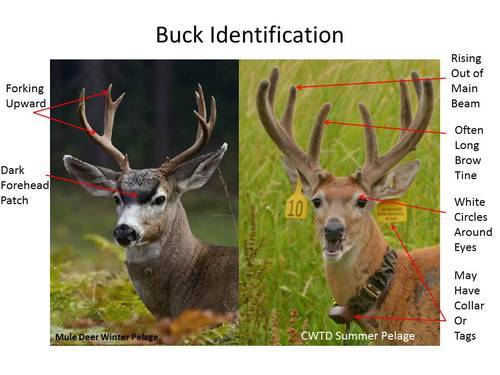
First a little quiz. Question #1: Which deer is endangered?
Question #2. Here’s a tougher one. Distinguish the deer on the right with the deer below.
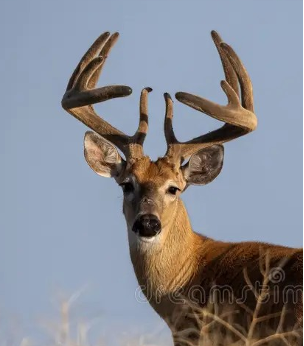
The US Fish and Wildlife Service (USFWS) provides hunters some online images to help in distinguishing endangered deer from deer that may be hunted. The endangered deer is on the right in the first photo (Duh, there are pretty obvious clues). It is a Columbian white-tailed deer while the deer on the left is a mule deer, and the one on the bottom is another white-tailed deer that you can shoot.
White-tailed deer (Odocoileus virginianus) are among the world’s most widely distributed mammals, ranging from Alaska (a range expansion) to Peru. White-tailed deer are estimated, for larger terrestrial species, to be Earth’s most numerous wild mammal.[1]
White-tailed deer reportedly rank only behind humans, dogs and cats, various livestock, and five whale species in terms of total biomass (one blue whale equals a lot of white-tailed deer).[2]
In the 48 coterminous US states white-tailed deer are so numerous – tens of millions –they are commonly considered a nuisance. This was not always the case. They have rebounded from severely depleted populations (as few as 300,000 ), having been almost eradicated in some states such as Rhode Island.[3] Today, Rhode Island commonly supports 15 to 20 white-tailed per square mile except in suburban areas where the density maybe double that, and well over a dozen states have populations numbering in the millions. [NOTE: “300,000” to be linked to file included in 4:32pm 7/16 email and again below].
In the continental US, the species can be found in forest, scrub, wetlands and suburban backyards from the East Coast westward. There, their range meets the range of their larger cousin, the mule deer with its subspecies the black-tailed deer (Odocoileus hemionus and O. hemionus columbianus). Mule deer occupy and dominate much the habitat westward to the Pacific. The white-tailed species’ range does however continue to extend westward including to cover parts of Washington and Oregon. Enter the ‘Columbian white-tailed deer.’
The ‘Columbian white-tailed deer’ is a subspecies of white-tailed deer with a historical and current range that includes parts of Washington and Oregon.
Subspecies are an inherently more subjective taxonomic unit compared to the unit species. Species are based upon organisms’ ability to and actually reproducing viable offspring. Subspecies, however, may be differenced from one another on combinations of various of factors such as morphology (body measurements, pelt color, etc.), geographic occurrence, or DNA). Subspecies are more subjective and are commonly in dispute.
Whether a subspecies is valid or not often boils down to different schools of thought. There those who ‘lump’ organisms together despite a range of variation (lumpers) and those who split the group into multiple subspecies (splitters). USFWS has institutionally tended to be the latter; it increases the agency’s regulatory reach over smaller groupings or organisms. Smaller groups generally have smaller populations and ranges and each threat consequently appears to be graver. USFWS’s ECOS website states “the Columbian white-tailed deer… is one of 38 recognized subspecies of” white-tailed deer.[4]
The Columbian white-tailed deer, however, is not included on the Threatened and Endangered Species List as a subspecies. It is listed a distinct population segment or DPS, another lesser division and one with legal origins from Capitol Hill not biology. The term came to prominence through the Endangered Species Act (ESA). The Columbian white-tailed deer is a subset of a subset of the most abundant large terrestrial, wild mammal there is and a questionable one at that.
In a working paper by Zink and Klicka, the authors state this subspecies is not valid.[5] They opine there might be only one better caricature of hazily defined subspecies, a species for which one can’t tell “where it starts and stops being intermediate.” They refer to a putative subspecies of turkey with the scientific name Meleagris gallopavo intermedia. The name coveys that this turkey ‘subspecies’ was considered intermediate between two other subspecies (kind of like one without freckles, one with a few freckles sometimes (intermediate), and one with freckles).
The Columbian white-tailed DPS has been on the List for a very long time, ever since there was one – List that is – and even before. Columbian white-tailed were covered under the law that preceded the ESA, the Endangered Species Preservation Act of 1966.[6] USFWS had two DPS’s of the Columbian white-tailed deer subspecies (the Douglas County and the Columbia River DPSs) included on the ESA’s List until 2003. That year it ruled that the Douglas County DPS had ‘recovered’ and that DPS was officially deregulated.[7]
The Columbia River DPS has now been on the List for more than a half century during which time the nation’s white-tailed deer population has exploded. According to USFWS, by 2016, the Columbia River DPS had “substantially improved” and “the DPS no longer met the definition of an endangered species.”[8] The agency downlisted the species (reduced it from endangered to threatened status). Someday, perhaps the Columbia River DPS will make it off the List as well. Until then, hunters can take note of the handy comparison photos.
[1] L. Greenspoon, E. Krieger, R. Sender, Y. Rosenberg, Y.M. Bar-On, U. Moran, T. Antman, S. Meiri, U. Roll, E. Noor, & R. Milo, The global biomass of wild mammals, Proc. Natl. Acad. Sci. U.S.A. 120 (10) e2204892120, https://doi.org/10.1073/pnas.2204892120 (2023).
[2] Nick Routley, Visualizing the Biomass of All the World’s Mammals Visual Capitalist.com, April 28, 2023. https://www.visualcapitalist.com/biomass-of-mammals/#.
[3] Department of Environmental Management, White-tailed deer, State of Rhode Island, N.D. https://dem.ri.gov/sites/g/files/xkgbur861/files/programs/bnatres/fishwild/pdf/deer.pdf.
[4] USFWS, Columbian white-tailed deer (Odocoileus virginianus leucurus), ECOS, N.D, https://ecos.fws.gov/ecp/species/154.
[5] R. Zink and L. Klinka, Working Paper: The Taxonomic Basis of Subspecies Listed as Threatened and Endnagered Under the Endangered Species Act, Center for Growth and Opportunity, Utah State University, June 22, 2022. https://www.thecgo.org/research/the-taxonomic-basis-of-subspecies-listed-as-threatened-and-endangered-under-the-endangered-species-act/.
[6] Office of the Secretary of the Department of the Interior, Federal Resister, Vol. 32, No. 48, March 11, 1967, p. 4001, https://www.govinfo.gov/content/pkg/FR-1967-03-11/pdf/FR-1967-03-11.pdf#page=1).
[7] USFWS, Final Rule To Remove the Douglas County Distinct Population Segment of Columbian White-Tailed Deer From the Federal List of Endangered and Threatened Wildlife, Federal Register, Vol. 68, No. 142, July 24, 2003, p. 3467. https://www.govinfo.gov/content/pkg/FR-2003-07-24/pdf/03-17756.pdf#page=1.
[8] USFWS Reclassifying the Columbia River Distinct Population Segment of the Columbian White- Tailed Deer as Threatened With a Rule Under Section 4(d) of the Act , Federal Register, Vol. 81, No. 200, October 17, 2016, p. 71386. https://www.govinfo.gov/content/pkg/FR-2016-10-17/pdf/2016-24790.pdf#page=1.