By Rob Gordon and David Kreutzer, PhD.
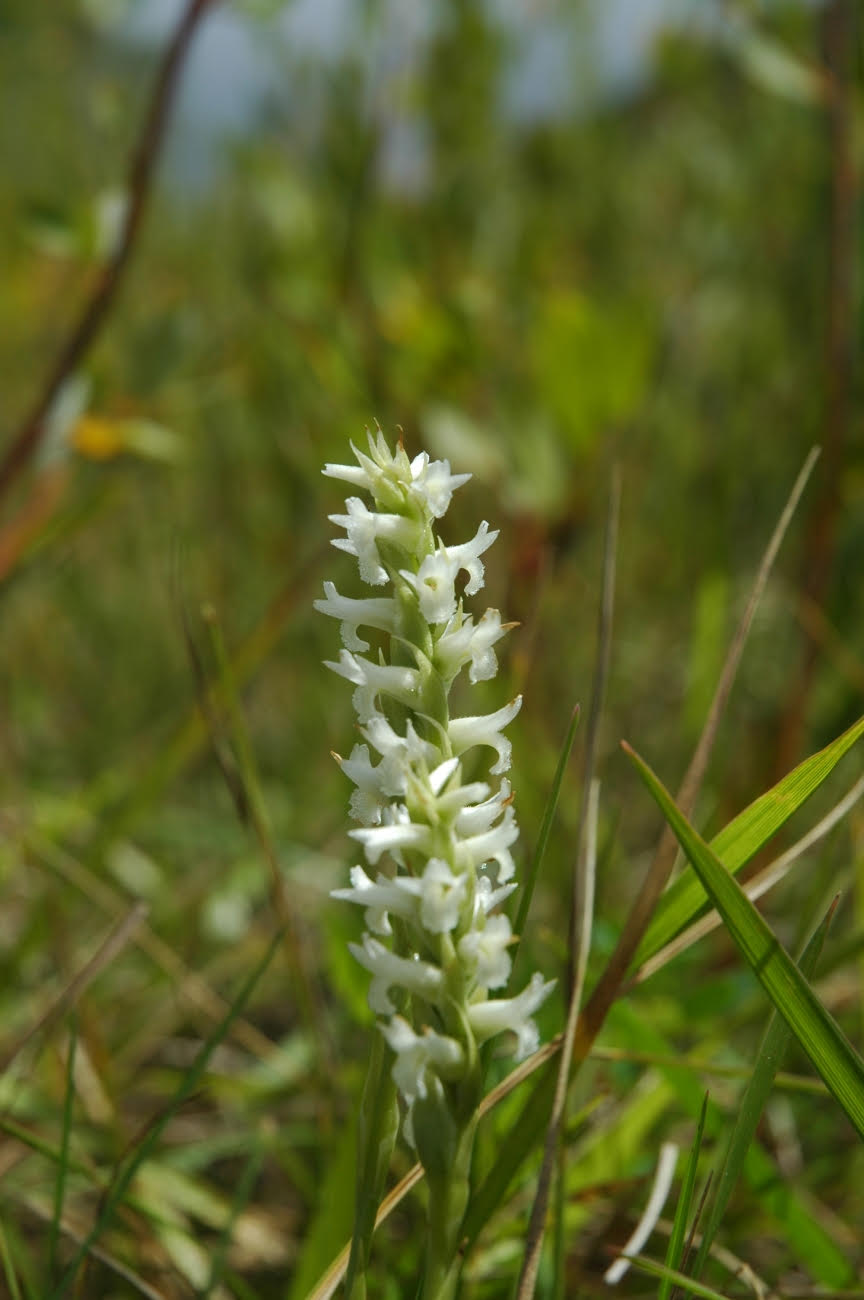
The declaration of a successful recovery of an endangered species and the call for its removal from the List of Endangered and Threatened Species should be the occasion for a celebration. On January 6, right before the Trump administration took over, the U.S. Fish and Wildlife Service (USFWS) proposed just that for a western orchid called the Ute ladies’-tresses.[1]
They have solicited comments.
Okay, USFWS, you asked for it, so here goes:
This is no occasion for celebration. Rather, it is the time for revealing the deceit and obfuscation that permeates so much of the Endangered Species Act (ESA) program.
Make no mistake, the Ute ladies’-tresses should be delisted, immediately, but only because it should never have been on the list in the first place, not for the fundamentally dishonest claim that the plant ‘recovered.’ Instead of an ESA success story, this plant is an object lesson in how the ESA is abused to thwart development, expropriate property, and to undermine economic growth, rather than recover endangered species.
In 1990 USFWS proposed a regulation to add Spiranthes diluvialis – the Ute ladies’-tresses to the List as a ‘threatened’ species.[2] USFWS stated there were “fewer than 3,000 individual plants” and only 7 “small populations” found in just Colorado and Utah and, historically, Nevada. Commenters on the proposal questioned “whether there are sufficient data and evidence to support listing.” Unswayed, USFWS listed the plant in 1992, mentioning there were now known to be “fewer than 6,000 individuals in 10 known populations.”[3]
Portending future revelations, before any recovery actions, it was already double the number previously claimed.
Then came a never-to-be-finalized 1995 recovery plan that sought protection from virtually anything humans might do and had been done since “Europeans” settled in the orchid’s possible habitat or near it.[4] In a bit of irony, the draft plan notes that a “large population” of the flower “recently developed in an abandoned gravel pit.” Others would be found along railroad tracks and in roadside irrigation ditches. These plants clearly were not as finicky as USFWS would have one believe. Indeed, by the time the draft plan was written, the estimated number of plants had risen to 20,500 and its occurrences to 12 now including plants in Montana and Wyoming. USFWS admits that these and future reported ‘increases’ in the plant’s range, number of locations where individuals occurred, and total number of plants were not due to real increases but, rather, to more accurate data.
By 1996 it was clear the original listing was a mistake. USFWS was petitioned in May of that year to delist the plant because its ‘threatened’ designation was erroneous – there were more of them and they could be found in many more states.[5] This was the time for a celebration; ‘Hooray, there are way more than we said; they aren’t threatened.’ Instead, USFWS engaged in Olympic-level foot-dragging.
Required by law to respond in 90 days, USFWS did not respond for more than eight years. When it did in 2004, USFWS acknowledged they estimated there were over 60,000 thousand orchids including plants in yet even more states – Idaho, Nebraska and Washington.[6] The next year another study reported over 83,000 plants.[7] After that, USFWS quit estimating but acknowledged the plant inhabited at least eight states and had over 60 occurrences (the definition of an ‘occurrence’ was changed, obscuring even greater growth from the original 7 “small populations”).
USFS’s excuse for the delay was that they were busy doing ‘higher priority’ stuff. They were also too busy to make the finding required in the 12 months following the “90-day” response. That took another two decades – the dishonest 27,000 word, 34 page proposed January regulation. It, incidentally, also acknowledges the plant has been found in British Columbia, Canada. It is now known to occur in at least five more states and one more country than where it was known to have historically occurred when declared ‘threatened.’
The higher priorities making USFWS too busy included fabricating regulatory hoops by invoking the falsely ‘threatened’ orchid during review of at least a dozen federal actions – from issuing gazing permits to the Corps of Engineers’ issuance of a wetland filling permit for 1/3 of one acre. The latter was 1% of the plant’s habitat at a proposed development of 89 homes on a 100-acre ranch.[8] USFWS reported 56 of the plants were projected to die from a boardwalk constructed to avoid the habitat but which would deprive some flowers of sunlight. USFWS reported a laundry list of conservation measures imposed on the project including that the remaining 32 acres of plant habitat be put into a conservation easement with a non-profit. The new home development was eventually abandoned and the property reportedly sold to a partnership affiliated with the Aspen Valley Polo Club for polo fields.[9]
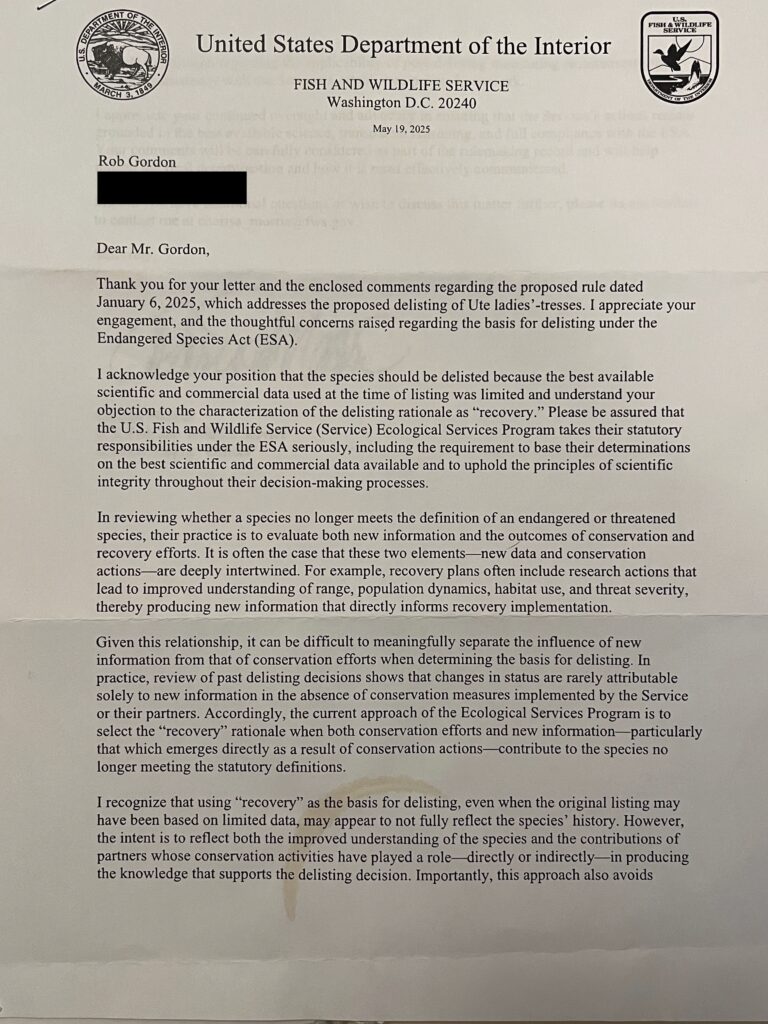
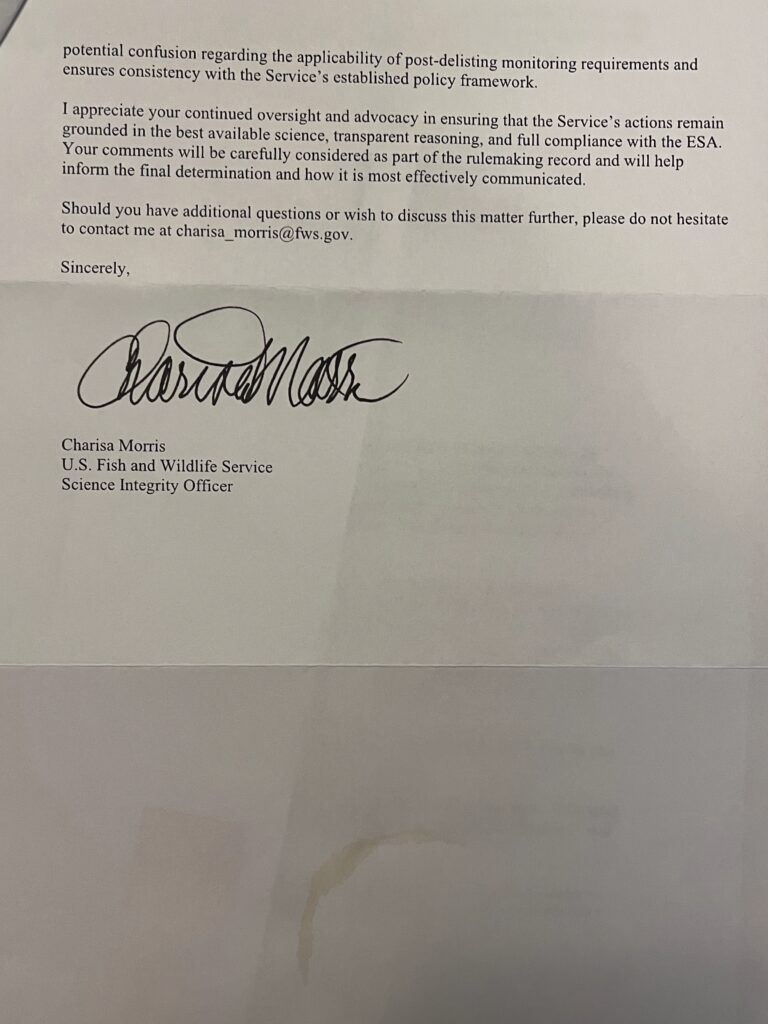
USFWS’ current delisting proposal includes a provision to misappropriate more money to monitor this clearly never-threatened plant for at least another decade after delisting to ensure it does not need to be added back to the endangered list. USFWS’s January proposal claims the plant has ‘recovered’ and the accompanying press release touts the plant’s “remarkable” “surge” in numbers and range. This whole process has been bereft of scientific integrity and filled with unconscionable regulatory abuse in the name of a falsely endangered species. This is all well documented in comments submitted to the USFWS.[10] [This document was sent within 7/16 email at 4:32pm and titled Comments on Ute Ladies’-Tresses Proposed Delisting] These were sent to USFWS’s scientific integrity officer as well. The responsewas nothing but mush. [I have included in the same email a letter as two images – was not sure how to join them.]
The paucity of rigorous scientific inquiry – to be extremely generous – isn’t unique. A report published by the Western Caucus Foundation examines a fraction of federally ‘endangered’ plants and animals, conservatively reveals dozens and dozens of others that were put on the list erroneously.[11] Many were similarly falsely proclaimed to have recovered (e.g. Hoover’s Woolly-star, the Monito gecko, and San Clemente sage sparrow) while have been similarly dishonestly proposed as recoveries (e.g. gypsum buckwheat, the Puerto Rican boa, and Nashville crayfish). Bogusly listed species are regulatory pawns invoked at will to penalize landholders and thwart human activity while filling the coffers of some suing to “save them” and funding others busy studying them or those contracted to navigate the regulatory labyrinth. Keeping these species listed or dishonestly proclaiming them successful ‘recoveries’ hides the ESA’s profound flaws. Saving species from extinction is a laudable goal, but hijacking an ostensibly well-intended law to grab arbitrary power isn’t.
Dr. Kreutzer, a former economics professor, has worked on a variety of policy issues and was on the transition team at the EPA during the first Trump Administration.
[1] USFWS, Endangered and Threatened Wildlife and Plants; Removal of Ute Ladies’-Tresses From the List of Endangered and Threatened Plants, Federal Register, Vol 90, No. 4, 1/6/2025, pp. 1054-1078.; and Ute Ladies’-tresses Proposed for Delisting Due to Conservation Efforts: ESA protections have secured a future for this terrestrial orchid found in the western United States and Canada, Press Release, 1/6/2025. (https://www.fws.gov/press-release/2025-01/ute-ladies-tresses-proposed-delisting-due-conservation-efforts; accessed 2/24/25)
[2] USFWS, Proposal to List the Plant Spiranthes diluvialis (Ute ladies’-tresses) as a Threatened Species, Federal Register, Vol. 55, No. 219, 11/13/1990, p. 47347-47350.
[3] USFWS, Final Rule to List the Plant Spiranthes diluvialis, Ute Ladies’-Tresses, as a Threatened Species, Federal Register, Vol. 57, No. 12, 1/17/1992, p. 2048-2053.
[4] USFWS, Draft Recovery Plan: Utah Ladies’-Tresses (Spiranthes diluvialis), Publication Date: 9/21/1995 (per ECOS, Spiranthes diluvialis profile).
[5] Don Christiansen, General Manager, Petition to Delist from the Central Utah Water Conservancy District, 5/10/1996. (Referenced at 69 FR, No. 196, 10/12/2004, p. 60606; and on ECOS profile for Spiranthes diluvialis.
[6] USFWS, 90-Day Finding on a Petition To Delist the Ute Ladies’-Tresses Orchid and Initiation of a 5-Year Review, Federal Register, Vol. 69, No. 196, 10/12/2004, pp. 60605-60606.
[7] Fertig et. al 2005: Fertig, W., Black, R. and Wolken, P. 2005. Rangewide status review of Ute ladies’-tresses (Spiranthes diluvialis). “Prepared for the US Fish and Wildlife Service and Central Utah Water Conservancy District,” September 30, 2005.
[8] USFWS, Biological Opinion Rendered (Final), 06E24100-2011-E-00026, 10/27/2010.
[9] Burton 2017: Burton, Lynn, The TCI Ranch sells for 7.2 million, Sopris Sun, June 21. 2017, online.(https://soprissun.com/tci-ranch-sells-for-7-2-million/, accessed 2/19/2025).
[10] Gordon, Rob, Comments on USFWS’s Proposed Rule to Remove Ute Ladies’-Tresses (Spiranthes diluvialis) from the List of Federally Endangered and Threatened Species on the Basis that this Plant Purportedly “Recovered,” March 9, 2025.
[11] Gordon, Rob, The ESA at 50, The Western Caucus Foundation, December 2023. (https://www.westerncaucusfoundation.org/wp-content/uploads/2023/12/Endangered-Species-Report-Final.pdf, accessed 2/21/25).